
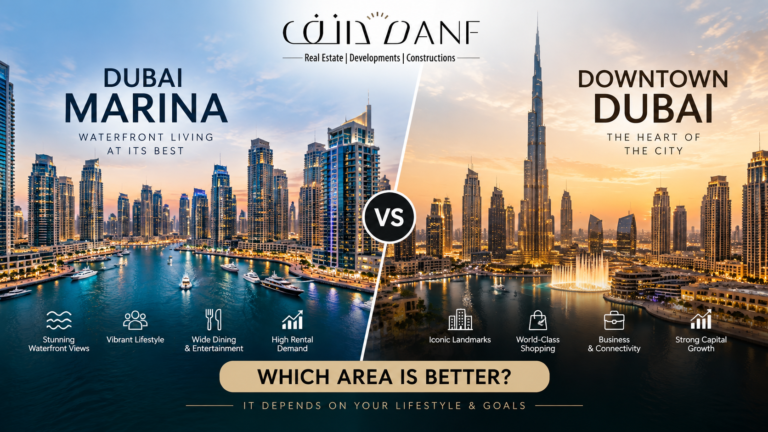
For most buyers, Dubai Marina vs Downtown Dubai comes down to one trade-off. Dubai Marina usually offers a lower purchase price, waterfront living and stronger gross rental yield, while Downtown Dubai asks buyers to pay more for a central address, landmark views and faster access to the city’s main business districts.
Neither area wins every category. A one-bedroom investor may prefer Marina economics, while a buyer who works near DIFC and values Burj Khalifa proximity may accept Downtown’s higher entry price. This guide covers prices, rental returns, short-term letting, capital appreciation, daily living and the building-level risks that can change the result.
At a glance
Community reputation is only the starting point. Two units on the same street can produce different returns because of service charges, layout efficiency, view, floor level, parking, building management and refurbishment history.
| Factor | Dubai Marina | Downtown Dubai |
|---|---|---|
| Location | New Dubai, beside JBR, Bluewaters and Dubai Harbour | Central Dubai, beside Business Bay and DIFC |
| Atmosphere | Waterfront, active, leisure-led | Urban, polished, landmark-led |
| Entry price | ~AED 800,000 (studios) | ~AED 1.1 million (studios) |
| Price per sq ft | ~AED 2,315 (Jul 2026) | ~AED 3,357 (Jul 2026) |
| Beach access | Strong — JBR beach nearby | None direct |
| Best suited for | Waterfront living, yield-focused buying | Central living, prestige, prime-city ownership |
Everyday living
Dubai Marina
Marina works best for people who want to walk out of a tower and reach restaurants, cafés, the promenade, gyms and supermarkets without planning every trip around a car. Balconies, marina views and evening walks carry real value for residents, not just marketing value.
- Marina Walk and nearby JBR create strong restaurant and leisure access
- The Metro and tram reduce dependence on a car for some commuters
- Weekend and evening traffic can slow near key entry points
- Older towers need closer checks on lifts, cooling systems and reserve-fund quality
Downtown Dubai
Downtown feels central and vertical, wrapped around offices, hotels, retail and tourism. Executives who spend the week in central Dubai can justify the premium because the location cuts repeated cross-city travel — DIFC, Business Bay and the airport all sit close by.
- Short road access to Business Bay, DIFC and major city routes
- Address recognition supports resale liquidity in strong buildings
- Dubai Mall, Dubai Opera and the Burj Khalifa district draw year-round footfall
- New construction and event traffic can affect noise or views
For buyers weighing the best area to live in Dubai Marina or Downtown Dubai, the choice tends to follow the weekly routine, not the postcard image: choose Marina for beach access and an active neighborhood, choose Downtown for a short commute into DIFC or Business Bay and immediate access to Dubai Mall.
These 2026 asking ranges give a more useful starting point than a single community average — though they compress very different buildings into one number, so always check recent transactions in the same tower before making an offer.
Ready and off-plan stock need separate treatment. A ready Marina apartment gives rental evidence, a service charge history and a physical view to inspect. Off-plan Downtown one-bedroom pricing ran around AED 3,051 per square foot in July 2026 — new-build pricing can move differently from older ready stock. Never stop at the headline number; compare total acquisition cost, annual charges, furnishing and the price a future buyer would see as competitive.
Which area offers better rental returns?
Marina currently has the stronger community-level yield case for a Dubai Marina property investment.
Different methodologies produce different percentages, but both point to the same ranking. That makes Dubai Marina vs Downtown Dubai rental yield useful as a screening question, not a final answer — net return depends on what remains after ownership costs:
- Service charges — high-amenity and branded towers can erase part of a strong gross yield
- Furnishing — short-term and premium long-term tenants expect a higher specification in both areas
- Management fees — hands-off owners need leasing, inspection and guest-management costs
- Vacancy periods — a two-week gap and a two-month gap produce very different annual numbers
- Maintenance — appliances, AC, plumbing and furniture replacement belong inside the model
A useful net-yield calculation: annual rent minus service charges, management, maintenance and expected vacancy, divided by total acquisition cost. A lower-priced Marina unit can post a stronger percentage return, but a poorly managed older building can absorb that advantage.
Downtown has the stronger scarcity and prestige argument in its best micro-locations. Marina has the stronger value-entry argument, where buyers can acquire a good view and large layout at a lower price per square foot. Neither case holds across every tower — Dubai completed 104 real estate projects worth more than AED 111 billion during H1 2026, so future supply is not an abstract risk.
- New supply — Downtown still receives high-profile launches; Marina and the waterfront corridor keep adding premium inventory
- International recognition — both rank highly, though Burj Khalifa proximity gives Downtown a global landmark edge
- Building age and quality — Marina has a wider spread between older and newer tower standards
- Future projects — new towers can improve an area while diluting the exclusivity of a specific view
Q1 2026 luxury real estate investment in Dubai reached AED 87.71 billion, and foreign investment hit AED 148.35 billion — up 26% year on year. Active luxury demand supports prime-city and waterfront assets, but it also raises the cost of paying for branding or a view that may not translate into equal resale growth.
Short-term rentals
Marina guests
Beach visitors, couples and leisure travelers who like JBR, the promenade and access toward Palm Jumeirah. Short stays work best in well-furnished units with a real water or skyline selling point.
Downtown guests
Landmark tourism, shopping trips and business stays close to the Burj Khalifa. Units where guests can walk to major attractions without relying on taxis perform best for a Downtown Dubai property investment.
Dubai requires holiday-home operations to follow the applicable tourism licensing and approval framework — confirm the property and operator requirements before advertising any short-let unit.
Risks buyers should consider
Prime addresses can hide expensive weaknesses. Inspect the asset with the same care you would apply in a less famous community.
High service charges
Ask for the current approved charge and recent history, then model it against achievable rent.
Traffic and construction
Test the commute during real travel hours, and check nearby plots for active or planned projects.
Ageing towers
Review common areas, façade condition, cooling, water pressure and recurring repair complaints.
View obstruction
A premium sea, marina, fountain or Burj view needs a surrounding-plot check before you pay for it.
Advertised vs net ROI
Deduct charges, management, vacancy, maintenance and furnishing replacement from any headline yield figure.
Dubai’s Q1 2026 market recorded 60,303 transactions, a 6% annual increase. High activity helps liquidity, but it also means a weak layout or overpriced unit can stay exposed even inside a famous neighborhood.
FAQs
No. Downtown usually carries the higher average price per square foot, although individual luxury Marina properties can exceed comparable Downtown homes.
Marina generally posts the stronger gross yield. Net performance still depends on service charges, vacancy, maintenance, furnishing and management costs.
Both can work, but families should compare unit size, school routes, noise, parking and building facilities before choosing a district.
Both attract tourists. Marina suits beach-led stays, while Downtown suits landmark, shopping and business demand.
Is Downtown Dubai a better long-term investment?
It can be for buyers prioritizing central scarcity and prime-city status. Building quality, purchase price and future supply still decide performance.