
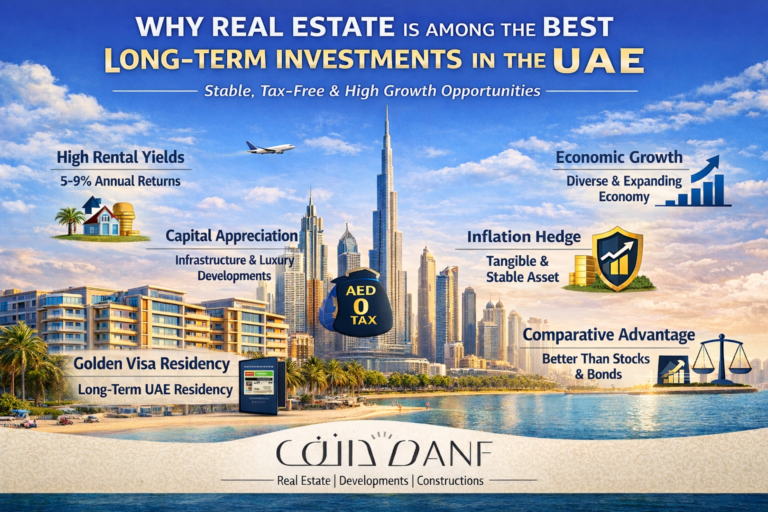
When evaluating long-term wealth-building strategies, one recurring question dominates investor discussions: why does real estate consistently outperform many other asset classes in the UAE?
The UAE property market offers a strong investment case due to high rental yields, infrastructure-driven capital appreciation, a tax-free environment, and investor-friendly ownership laws. These factors attract both regional and international investors looking for stable long-term returns.
Unlike volatile financial markets, real estate combines tangible asset ownership with recurring income potential. Supported by strong expatriate demand, a diversified economy, and continuous regulatory reforms, the UAE property market has become one of the most attractive investment destinations globally.
In this guide, we’ll explore:
High & Reliable Rental Yields
Capital Appreciation Over Time
Tax-Free Environment & Investor-Friendly Laws
Economic Growth & Demand Drivers
Stability, Inflation Hedging & Tangible Asset Value
Risks & Considerations
Comparative Advantages Over Other Investments
Frequently Asked Questions (FAQs)
High & Reliable Rental Yields
One of the most compelling reasons investors choose UAE real estate is its strong rental yield potential.
In cities like Dubai and Abu Dhabi, rental yields commonly range between 5% and 9% annually, which is significantly higher than many mature global markets such as London, New York, or Singapore.
Several factors drive this consistent rental demand:
A large expatriate population requiring rental housing
A strong tourism sector boosting short-term rental markets
Continuous business expansion attracting global professionals
This steady demand helps property owners generate reliable passive income streams over the long term.
Capital Appreciation Over Time
Beyond rental income, property values in the UAE have demonstrated strong long-term growth.
Major infrastructure projects — such as new metro lines, highways, and integrated master communities — often increase property values in surrounding areas. Improved connectivity and urban planning make neighborhoods more desirable, leading to price appreciation over time.
Luxury real estate in prime districts such as Dubai Marina, Downtown Dubai, and Palm Jumeirah has historically shown resilience during market cycles due to strong global demand and limited supply.
Off-plan properties also present opportunities for capital gains. Investors who purchase during the early stages of development may see property values rise significantly by the time of project completion.
Tax-Free Environment & Investor-Friendly Laws
One of the biggest financial advantages of investing in UAE property is the absence of most real estate taxes.
Property investors typically benefit from:
No property tax
No capital gains tax
No tax on rental income
This tax-free structure allows investors to retain a higher percentage of their returns, aside from transaction costs like transfer fees or service charges.
The UAE also permits foreign investors to own freehold properties in designated zones. This provides full ownership rights and legal protection.
Additionally, the UAE Golden Visa program offers long-term residency benefits for property investors. Investments starting from AED 2 million may qualify investors and their families for renewable long-term residency.
Economic Growth, Demographics & Demand Drivers
The UAE’s economic growth plays a major role in strengthening its real estate market.
Rapid population growth driven by expatriate professionals and international migration continues to expand housing demand across the country. As more people relocate for employment and business opportunities, both rental and ownership markets benefit.
The country’s diversified economy also contributes to long-term stability. Major sectors supporting growth include:
Tourism
Finance
Technology
Trade and logistics
This economic diversity reduces dependence on oil and supports consistent real estate activity and investor confidence.
Furthermore, world-class infrastructure, luxury lifestyle developments, and modern urban planning make the UAE an attractive destination for both residents and investors.
Stability, Inflation Hedging & Tangible Asset Value
Real estate is a physical and tangible asset, which often makes it less volatile than stocks or speculative financial instruments.
During periods of economic uncertainty, property tends to retain intrinsic value more effectively than many financial assets.
Real estate also acts as a hedge against inflation. As construction costs, land values, and rental prices increase over time, property values and rental income often rise as well.
In addition, regulatory reforms — including mandatory escrow accounts, developer regulations, and enhanced market transparency — have significantly strengthened investor protection in the UAE real estate sector.
Risks & Considerations
While the UAE property market offers strong long-term potential, investors should also consider potential risks.
Oversupply can occur in certain districts where large numbers of new units enter the market simultaneously. This can temporarily affect rental yields or property prices.
Other factors to consider include:
High upfront investment costs
Transfer fees and agent commissions
Ongoing service charges and maintenance fees
Liquidity is another important factor. Unlike stocks, real estate transactions take time, and luxury or niche properties may take longer to sell.
Careful market research and location selection are essential to minimize these risks.
Comparative Advantage Over Other Investments
Compared with other investment options, UAE real estate offers a balanced combination of stability, income potential, and long-term growth.
| Investment Type | Stability | Return Potential | Liquidity |
|---|---|---|---|
| UAE Real Estate | High – tangible asset and regulated market | Rental yields 5–9% plus capital appreciation | Low–Medium |
| Stocks/Equities | Variable | Potentially high but volatile | High |
| Bonds | Moderate | Lower returns | High |
| Alternative Assets (Crypto/Gold) | Variable | High risk and high reward | Generally liquid |
This balance makes property an attractive option for investors seeking steady long-term wealth creation.
Key Takeaways
UAE real estate offers strong rental yields and consistent passive income.
Capital appreciation is supported by infrastructure development and growing demand.
The tax-free investment environment significantly improves net returns.
Property provides a stable, tangible asset that hedges against inflation.
Regulatory improvements and transparency have strengthened investor protection.
However, investors should also consider factors such as oversupply risks, upfront costs, and lower liquidity compared to financial assets.
Frequently Asked Questions (FAQs)
What is the typical break-even period for property investment in Dubai?
Depending on location and rental yield, many residential properties recover their purchase cost through rental income in approximately 10–12 years.
Can foreigners own property in the UAE?
Yes. In designated freehold zones, foreign investors can own property outright with full ownership rights.
Are there taxes on rental income in the UAE?
Generally, no property taxes, rental income taxes, or capital gains taxes apply in most emirates.
What risks should investors consider?
Oversupply in certain areas, service charges, maintenance costs, and slower property liquidity compared to financial assets.
Can property investment provide UAE residency?
Yes. Investments of AED 2 million or more may qualify investors for long-term residency through the UAE Golden Visa program.