
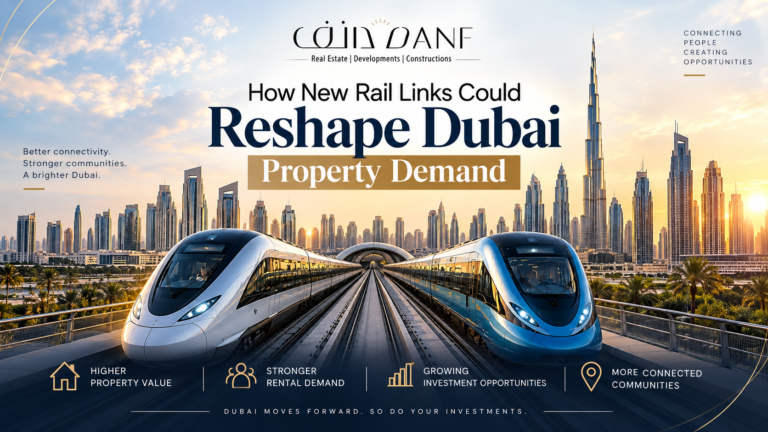
Dubai’s property market is entering a new phase — one where “location” may soon be measured less by distance to the city centre and more by ease of access. As new Metro and rail connections take shape, buyers and tenants are starting to weigh travel time, station proximity, and overall connectivity just as heavily as neighbourhood prestige.
For communities like Jumeirah Village Circle (JVC), Meydan, Dubai Silicon Oasis, and Dubai South, this shift could be transformative — turning areas once seen as car-dependent into genuinely competitive residential options.
Infrastructure changes how livable a neighbourhood feels. A community that once seemed too far from work becomes far more attractive once residents can reach business hubs without fighting peak-hour traffic every day.
This doesn’t mean central, established districts will lose their pull — they still offer convenience, prestige, and mature amenities that newer or outlying areas can’t fully replicate. But better public transport widens the pool of communities that renters and buyers see as realistic alternatives.
Key factors shaping this shift:
- Shorter, more predictable commutes
- Easier access to employment and education hubs
- Greater flexibility to find more space at better price points
The overall effect: a residential market where connectivity starts to rival distance as the defining factor in value.
The Blue Line Changes the Equation
The planned Metro Blue Line — a 30-kilometre, 14-station route targeted to open on September 9, 2029 — will connect several eastern districts that currently rely heavily on road access, including Dubai Silicon Oasis, International City, Academic City, Mirdif, and Al Warqa.
For Dubai Silicon Oasis, this matters because the community already blends housing, workplaces, schools, and nearby academic institutions. Direct rail access could make it significantly more appealing to professionals, students, and families looking for an established, self-contained neighbourhood that doesn’t demand a car for every errand.
International City stands to benefit too, especially among budget-conscious tenants who previously factored commute time as a drawback.
JVC and Meydan: Location Judged by Access, Not Just Address
Jumeirah Village Circle has become one of Dubai’s most active residential communities — despite having no direct Metro line today. Future rail expansion could reinforce its position further, making daily commuting genuinely convenient for residents working across the city.
Meydan could see a similar boost. It already sits close to key parts of Dubai, but added rail connectivity would make it a more practical choice for a broader mix of tenants and buyers.
Other areas tied to the proposed Gold Line corridor — including Jumeirah Golf Estates, Al Barsha South, Nad Al Sheba, and Mohammed Bin Rashid City — could also see demand spread more evenly, rather than clustering only around neighbourhoods with existing Metro access.
A caution worth noting: transport alone won’t drive performance. Housing quality, community amenities, supply pipeline, and long-term livability still matter just as much. A station improves access — it doesn’t replace good planning.
Dubai South: A Different Kind of Connectivity Story
Dubai South’s outlook is shaped by more than city-level transport — it’s also tied to broader inter-emirate rail plans. The area’s mix of residential growth, employment, logistics, and aviation-related activity gives it a demand profile unlike purely residential communities.
Stronger connections between Dubai and neighbouring emirates could make Dubai South especially attractive to frequent business travellers and residents who want to live near major employment zones while staying connected to the wider city. As transport, community services, and housing supply mature in parallel, the buyer and tenant pool here is likely to expand gradually.
Improved rail access could give residents more freedom to choose homes based on space, budget, and lifestyle — not just commute distance. Neighbourhoods that once felt inconvenient may become genuinely practical options as travel gets faster and more predictable.
For investors, the takeaway isn’t simply “buy near a future station.” Long-term demand is far more likely to hinge on a combination of:
- Transport access
- Pricing
- Housing quality
- Amenities
- Local employment opportunities
The Bigger Picture
Dubai’s next phase of residential growth is likely to follow its transport network closely. As new rail lines link previously car-dependent communities to the rest of the city, property demand could spread across a much wider range of neighbourhoods than before.
JVC, Meydan, Dubai Silicon Oasis, and Dubai South are all worth watching — each stands to benefit from improved accessibility in its own way. The strongest opportunities will likely emerge where transport upgrades are matched by solid fundamentals: sensible pricing, quality construction, and genuine long-term livability.
At Danf Group, we track these infrastructure shifts closely to help our clients identify communities positioned for durable, long-term value — not just short-term hype.